
Agent pane virtualization
The agent pane displays the conversation as an ordered list of DocumentNodes — one per assistant message, user message, tool call, agent-to-agent message, subagent link, etc. Long sessions accumulate 500-2000+ nodes. Rendering all of them in the DOM at once made the layout tree heavy enough that tab-switching INTO a pane with an active agent stalled for 200-300ms.
The renderer (frontend/app/view/agent/virtualization/) keeps only ~50 visible rows + 5-row overscan in the DOM at any moment, with the rest virtualized.
Three architectural decisions
Section titled “Three architectural decisions”1. Hybrid virtualization
Section titled “1. Hybrid virtualization”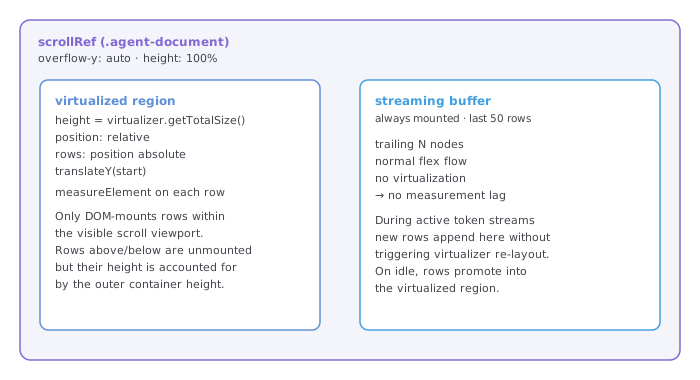
The virtualized region uses @tanstack/solid-virtual with absolute positioning and per-row ResizeObserver measurement. The streaming buffer (the trailing 50 rows) is rendered with a normal <Index> so token deltas to active streaming nodes update in place — no recycling, no measurement lag. As rows age past the buffer, they transition into the virtualized region by which point their measurement has stabilized.
Why <Index> and not <For> for the streaming buffer: each token replaces a node’s object reference (immutable update preserves id but produces a fresh value), and <For> reconciles by reference, which would unmount and remount the streaming row on every token. <Index> keys by position and exposes the item as a Solid signal, so the same DocumentRow stays mounted while its props.node() re-reads.
2. Scroll state in data, not DOM
Section titled “2. Scroll state in data, not DOM”Anchor and stick-to-bottom flags live in the Solid store (AgentViewState):
{ nodes: Accessor<readonly DocumentNode[]>, nodeIndex: Accessor<ReadonlyMap<string, number>>, // O(1) id → index stickToBottom: Accessor<boolean>, headAnchor: Accessor<{ nodeId: string, offsetPx: number } | null>, streamingNodeId: Accessor<string | null>, // ... atomic mutations: engageStickToBottom, captureHeadAnchor, ...}The DOM scrollTop is a projection of this state, never read back. When history pagination prepends 200 older nodes, the view captures the topmost-visible node id as an anchor, fetches, then restores scroll to that node’s new offset. The arithmetic uses node ids, not pixel deltas — robust against ResizeObserver-driven height changes that haven’t settled yet.
CSS overflow-anchor: auto on the scroll container is the cheap belt to the JS suspenders: Chromium auto-pins a visible anchor element when content above it changes height (image loads, tool block expand). The JS layer handles the cases CSS can’t (programmatic scroll, remount).
3. Per-kind size estimators + intelligent perf probing
Section titled “3. Per-kind size estimators + intelligent perf probing”Each DocumentNode kind declares its own size estimator in the renderer registry:
| Kind | Estimator |
|---|---|
agent_message | text-line heuristic, capped at 320px |
user_message | same, collapsed → 32px |
tool | pinned (expanded) → 200px, collapsed → 32px |
agent_section | 48px |
markdown | text-line heuristic |
subagent_link | 56px (fixed) |
These replace the single estimateSize: () => 80 from the first retrofit attempt, which produced visible gaps because short messages were given 80px slots.
A dev-mode perf probe (agent-pane-perf-section.tsx, a section of the diagnostics panel, which dev builds toggle with Ctrl+Alt+Shift+F12, or Cmd+Alt+Shift+F12 on macOS) compares each row’s measured size against its kind’s estimate. When p50 measured size diverges from the estimate by more than 30%, the section flags the kind for recalibration. Per-kind p50/p95/max render times also surface here, plus layout-shift events scoped to the agent pane.
All probing is dev-only — import.meta.env.DEV is folded to a literal at build time, dead-code elimination drops the probe paths from production bundles.
What changes for users
Section titled “What changes for users”Nothing visible in the happy path. The pane scrolls, paginates, jumps to bookmarks, and streams content as before — just with a bounded layout-tree memory cost regardless of session length.
You may notice:
- Tab-switch into a populated agent pane is dramatically faster. The 200-300ms long-task storms during reflow are gone; the layout tree is constant-size.
- Auto-scroll-to-bottom is more deterministic. Sticky behavior is data-driven (
stickToBottomflag) instead of read-from-DOM heuristics. - Pagination is smoother. Anchor-based scroll preservation doesn’t drift on slow image/font loads.
Source layout
Section titled “Source layout”frontend/app/view/agent/virtualization/:
| File | Purpose |
|---|---|
state.ts | AgentViewState factory — single source of truth for scroll + streaming state |
anchor.ts | Pure scroll-anchor math (capture, restore, near-top/near-bottom) |
streaming-buffer.ts | partitionForVirtualization(nodes) splits the document into virtualized + streaming halves |
renderers.ts | Per-kind renderer registry with estimators and streaming-capability flags |
DocumentRow.tsx | Single row component used by both regions; caller controls positioning via style + ref |
AgentDocumentVirtualList.tsx | Hybrid renderer wiring everything together |
perf-probe.ts | Dev-mode per-kind timing + estimator-miss detection + layout-shift attribution |
frontend/app/devtools/agent-pane-perf-section.tsx — the diagnostics-panel section that polls agentPerfStore.snapshot() at 1 Hz and renders the per-kind table.
Reference
Section titled “Reference”- Spec:
docs/specs/SPEC_AGENT_PANE_VIRTUALIZATION_REDESIGN.md(in main repo) - PRs: #783 (foundation), #784 (virtualization layer), #786 (Show capture follow-up + reactive block components), #787 (perf probe)
- Issue: #782