
The reducer stack
AgentMux is built on a strict reducer model. Every cross-process state mutation goes through a single layer’s reducer, emits events that other layers project, and is persisted by the layer that owns the truth. This page is the entry point into that model.
The migration was tracked in docs/specs/MASTER_REDUCER_STACK_STATUS_2026-05-05.md in the source repo, with Discussion #707 as the rolling thread. Where either disagrees with the code, the code is current.
Why a reducer stack?
Section titled “Why a reducer stack?”Three pressures drove it:
- Multi-process truth — the launcher knows OS facts, the host knows CEF facts, the sidecar knows app facts. Without a reducer model, each process develops ad-hoc gossip channels and the shared mental model rots.
- Auditable mutations — every command leaves a trail. Bug reports become “find the last
dispatch(blockId, MoveBlockToWindow)for that block_id” instead of “did anyone callsetUrl()mid-load?”. - Testable invariants — pure
update(state, command)functions are unit-testable without a CEF context. Theagent-pane-stateslice has 32 invariants asserted in its test file alone; none of them require a running app.
The five layers
Section titled “The five layers”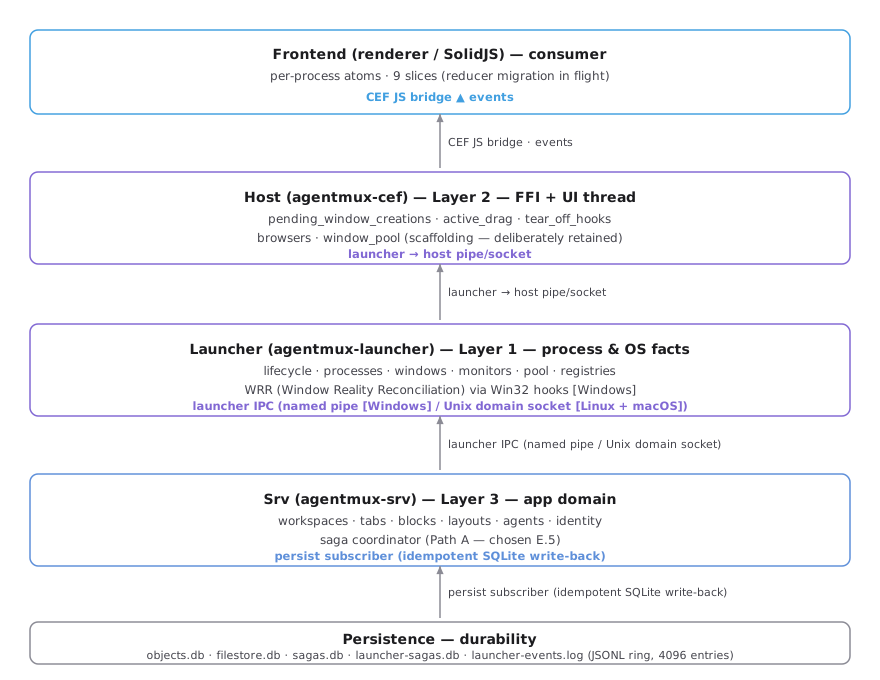
There are three reducers in Rust, one per process, each a pure update function over its own State:
| Launcher | Host (cef) | Sidecar (srv) | |
|---|---|---|---|
| Source | crates/launcher/src/reducer/ | crates/cef/src/reducer/ | crates/srv/src/reducer.rs + crates/srv/src/reducer/ |
| Commands | the shared agentmux_common::ipc::Command | its own HostCommand (30 variants), host-internal, never on a pipe | the shared agentmux_common::ipc::Command |
| Output | Vec<Event>, which the saga coordinator subscribes to | a DispatchOutput whose Win32/CEF effects the caller applies | Vec<Event>, which the persist subscriber writes to SQLite |
The launcher and srv reducers share the wire types and the same discipline (total, deterministic, the state lock held only for the dispatch), but not their State or the commands each handles. A command one of them doesn’t handle gets a non-fatal error event back rather than a silent success.
Layer 1 — Launcher
Section titled “Layer 1 — Launcher”Single-writer reducer over OS-level facts: processes, the mirror of every window, the warm pool, monitors and the instance registry. Lives in crates/launcher/src/reducer/. On Windows it also reconciles AgentMux’s own model against Win32 reality via WRR hooks. On Linux and macOS it is the same reducer behind a Unix-domain-socket IPC server; WRR is Windows-only by design (see WRR). Durable JSONL event log at <data-dir>/data/launcher-events.log. Status: done.
Layer 2 — Host
Section titled “Layer 2 — Host”CEF-side coordination, in crates/cef/src/reducer/: pending window creations, browser panes and the browser map, drag sessions, the window pool and the floating-pane pool, quit, per-window opacity, and floating-pane window state. Callers go through AppState::host_dispatch, which holds the state lock briefly and never across a CEF callback; the CEF calls the result asks for happen after it is released. Quit-on-last-window (#1676) routes through the count_live_user_windows gate in crates/cef/src/reducer/quit.rs, and the window-count consolidation (#1701) keeps the status-bar count accurate after CEF Views closes, via an explicit WindowClosed event plus snapshot reconciliation in the frontend. Status: done. The window-to-HWND map and redock’s window classification still live outside it; that remaining work is tracked in SPEC_REDUCER_SSOT_CONSOLIDATION_2026_06_22.
Layer 3 — Sidecar (srv)
Section titled “Layer 3 — Sidecar (srv)”Owns the app domain: workspaces, tabs, block ids, which workspace each window shows, and each tab’s layout tree with its focus and magnify. Lives in crates/srv/src/reducer.rs plus the per-domain modules in crates/srv/src/reducer/ (block.rs, tab.rs, layout.rs, lifecycle.rs, snapshot.rs, window.rs, workspace.rs). Multi-step commands (tear-off, restore, redock, delete) run as srv sagas. An idempotent persist subscriber writes the events back to SQLite. Status: done.
Layer 4 — Frontend slices
Section titled “Layer 4 — Frontend slices”Per-pane state cells that project the layers above into Solid signals. Each slice is a pure update(state, command) → { state, events } plus a slot store with register / dispatch / unregister lifecycle.
| Slice | What it owns | Status |
|---|---|---|
| #1 — agent-document-store | Per-pane document state cell | shipped |
| #2 — conventions | Slot lifecycle, audit trail, echo-loop guard | spec done |
| #3 — frontend-command-bus | Single outbound dispatch chokepoint | spec done |
| #4 — agent-pane-state-store | Streaming, sessionStats, currentTool, turnTokens, turnActive, stopping, pending | shipped |
| #5 — frontend-layout-reducer | Per-tab pane tree | spec done |
| #6 — launcher-event-reducer | Mirrors launcher window state into the frontend | shipped |
| #7 — tab-state-reducer | Active tab, tab order | spec done |
| #8 — pane-tree-reducer | Cross-tab pane mapping | deferred |
| #9 — browser-pane-state | Per-pane closed / loading / error / canGoBack / canGoForward / title (cells migrated); url, faviconUrl pending | partial: 4 phases shipped (3a/b/c/e); danger-cell url migration (3d) + slot store + recordDispatch (4) pending |
The pattern, end-to-end
Section titled “The pattern, end-to-end”A user clicks a link inside a browser pane. Here’s what happens:
- CEF captures the click. Win32
WM_LBUTTONDOWNfires on the pane’s HWND. - Host emits
browser-pane-clickedover the JS bridge. The launcher (Layer 1) records nothing — this is a renderer concern. - Frontend slice receives the event. The handler blurs any main-input that held stale DOM focus (so
giveFocus()doesn’t bounce OS focus back), then callsrefocusNode(blockId). Today this is a direct call site; Phase 4 routes it through aPaneClickedreducer command + slot dispatch so the audit ring records every transition. - Saga turns the event into a side effect: layout’s focus state updates. The layout slice (#5) records the change.
- Sidecar persists the new layout via the persist subscriber. The next time the user opens the same workspace, the focus is restored.
If any of those four hops fails — host doesn’t emit, slice doesn’t subscribe, saga drops the event, sidecar doesn’t persist — there’s exactly one place to look. That’s the value the reducer stack delivers over the prior ad-hoc model.
Auditing dispatches
Section titled “Auditing dispatches”Every slice routes through command-source.ts’s recordDispatch(...) helper, which appends a structured record (slice name, key, command, emitted events, source, timestamp) to an in-memory ring buffer. The diagnostics panel surfaces this; debugging a “what mutated this state?” question becomes filtering the ring for the relevant key.
How sagas fit
Section titled “How sagas fit”Sagas are the “what should happen as a side effect of this state change” layer: a multi-step flow that dispatches several reducer commands and reports its progress as SagaStarted, then SagaCompleted or SagaFailed. There are two saga frameworks, one in the launcher and one in srv. They share the module name and the event names, and nothing else. That split is deliberate, recorded in DECISION_SAGA_REDUCER_TWO_FRAMEWORKS_2026_09_07.md.
- Launcher (
crates/launcher/src/saga/): aSagatrait plus aSagaCoordinatorthat subscribes to the launcher’s event bus. A trigger event starts a saga, later bus events are routed into it throughon_event, and it answers withSagaActions (for example, a command for the host). It was built for flows that cross processes, and has two sagas:pool_respawn, which brackets refilling the window pool after a pool window is promoted, andwindow_cleanup, which brackets the cleanup after a user window closes. Their state lives in memory; there is no launcher saga database (the oldlauncher-sagas.dbis deleted at startup). Every transition is logged to the launcher log with a[saga]prefix. - srv (
crates/srv/src/sagas/): plain async functions. Each one allocates a saga id, emitsSagaStarted, drives its steps throughSagaCtx::dispatch(an in-process dispatch into the srv reducer, no IPC round trip), compensates withSagaCtx::compensateif a step fails, and emits the terminal event;run_sagawraps it with a timeout. Every srv saga changes only srv state, which is why it doesn’t use the launcher’s coordinator. The sagas tear off a tab or a block, restore a torn-off tab, promote a block to a tab, redock a floating pane, close a pane, and delete a block, a tab or a workspace. (The same module also holds agent teardown, the orphan reaper and the shutdown paths, which run outsiderun_saga.) Their steps are logged tosagas.db; see Persistence.
Frontend slices subscribe to the terminal saga events; orchestration is upstream. This is intentional: the frontend can’t be the source of truth for “did this flow actually finish?” — the answer lives in the saga’s own events, and the frontend projects it.
Persistence boundary
Section titled “Persistence boundary”Each layer’s persistence is independent:
| Store | Writer | What |
|---|---|---|
objects.db (SQLite) | sidecar | block / tab / window / workspace meta, layouts |
filestore.db (SQLite) | sidecar | per-block content blobs (agent configs, snapshots) |
sagas.db (SQLite) | sidecar | srv saga steps, compensated after a crash |
launcher-events.log (JSONL) | launcher | append-only event log; in-memory ring with disk overflow |
Launcher sagas aren’t persisted: their registry is in memory, and a fresh launcher starts with an empty one.
Each can be backed up independently. None of them depend on a single point of failure.
Reading the source
Section titled “Reading the source”The TypeScript slice surface is documented in the TypeScript API reference on this site (the four slice store files). For the host and sidecar reducer code, see the upstream Rust source in the agentmux repo: the reducers in crates/launcher/src/reducer/, crates/cef/src/reducer/, and crates/srv/src/reducer.rs with crates/srv/src/reducer/; the sagas in crates/launcher/src/saga/ and crates/srv/src/sagas/.
For deep design docs:
docs/architecture/DECISION_SAGA_REDUCER_TWO_FRAMEWORKS_2026_09_07.md— why the launcher and srv saga and reducer frameworks stay separatedocs/specs/MASTER_REDUCER_STACK_STATUS_2026-05-05.md— the migration’s status tracker, layer by layerdocs/specs/frontend-reducer-architecture-2026-05-03.md— frontend slice modeldocs/specs/frontend-reducer-conventions-2026-05-03.md— Command/event types, slot lifecycle, audit, echo-loop guarddocs/specs/frontend-reducer-implementation-plan-2026-05-03.md— slice ordering and PR boundaries- Discussion #707 — rolling thread; append PRs and gap closures here, don’t fork