
Architecture overview
AgentMux is a desktop application built around a small set of long-running processes that exchange events over named pipes (Windows) / Unix domain sockets (Linux + macOS) and a local websocket. Understanding the topology is enough to navigate the rest of the docs.
The four processes
Section titled “The four processes”
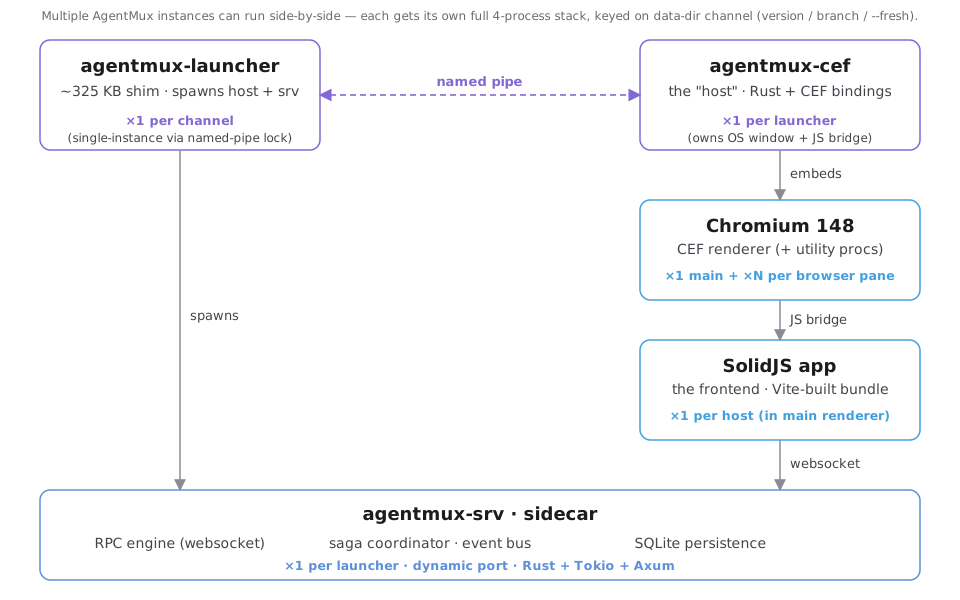
| Process | Role | Crate |
|---|---|---|
| launcher | Resilience and lifecycle layer on all platforms: spawns the host; owns the sidecar lifecycle; durable event log; single-instance enforcement per (channel, version) — the I1 isolation invariant keys the IPC socket/pipe on hash(data_dir + version). On Windows: sets DLL search path; tracks WRR (Window Reality Reconciliation) via Win32 hooks. On Linux: AppImage entry point (A0, v0.42.x); Unix-socket IPC server + full reducer + saga coordinator (A1, v0.42.x). task dev on all platforms runs through the launcher (v0.41.0+). | agentmux-launcher |
| host | Embeds Chromium via CEF; owns the windows (CEF Views top-level windows — browser_view_create + window_create_top_level, crates/cef/src/app/mod.rs), the browser panes, the JS bridge, and IPC fan-out to the renderer. New windows and tear-off floating panes are served from a hidden, pre-warmed pool (see below). | agentmux-cef |
| sidecar | App-domain server: workspaces, tabs, blocks, layouts, agents, identity. Persists to SQLite. Spawned and supervised by the launcher (which owns its lifecycle); listens on a dynamic local port and serves the host + frontend over a WebSocket. Users never run it directly. | agentmux-srv |
| renderer | A Chromium renderer process running the SolidJS frontend JS for one browser context. Not a singleton — every OS window gets its own renderer, and every browser pane inside a window adds another. Stateless — projects what the sidecar/host expose, dispatches user actions back through them. | frontend/ |
The Rust workspace has eight crates (Cargo.toml, [workspace] members). The three above, plus five that aren’t long-running processes of the instance:
| Crate | What it is |
|---|---|
agentmux-common | Shared library: path resolution (DataPaths), runtime mode, the IPC Command/Event types the launcher and sidecar reducers share, jekt signing. |
agentmux-mcp | The MCP server each agent’s CLI spawns over stdio. It advertises the MuxAPI tools and forwards each call to the sidecar. |
agentmux-bashwrap | The streaming bash wrapper for agents’ shell calls. It is also the program Claude Code’s PreToolUse, PreCompact and SessionStart hooks run, and ssh’s askpass when AgentMux runs ssh for an agent. |
agentmux-remote | The helper AgentMux installs on an SSH host: it keeps durable terminal sessions running there, serves the remote file protocol, and lists processes for Tower. |
agentmux-procstats | Per-process CPU and memory read without elevation, for Tower. Used by the sidecar and by agentmux-remote. |
The four processes above plus the Chromium subprocesses that the host transparently spawns (GPU, network, storage, …) are collectively one instance — a process tree rooted at one launcher. A baseline single-window dev session runs as launcher + sidecar + host + 1 renderer = 4 processes; opening more windows or browser panes spawns additional renderers. Multiple instances (different versions, dev + portable) run side-by-side without colliding — see Multi-instance & dev mode.
Why three real processes plus Chromium?
Section titled “Why three real processes plus Chromium?”Each process owns one concern, end-to-end:
- The launcher is the resilience and lifecycle layer. It is the only process that survives an unexpected OS-level event (a window minimize, a monitor disconnection, a focus theft). On Windows, its WRR layer reconciles AgentMux’s own model against what Win32 actually reports (Win32 hooks, WindowProc). On Linux (v0.42.x+), the launcher is the AppImage entry point and runs the full reducer + saga coordinator over Unix-domain-socket IPC. WRR is Windows-only by design (not a roadmap gap — see WRR); on macOS/Linux the cross-platform safety net for orphaned/crashed windows is the host’s orphan reconciler.
- The host is the only process with a CEF context. Windows are CEF Views top-level windows: the host calls
browser_view_create+window_create_top_leveland lets CEF Views handle resize, snap, and the frameless title bar natively. On Win32 the Viewswindow_handle()can come back NULL, so window operations resolve the realHWNDby enumeration. Browser panes, drag/drop, OS focus, and renderer crashes all live or die in the host. Crashing the host kills the user-facing window; the launcher restarts it. - The sidecar is the only process that owns durable state. The launcher spawns it (so its lifecycle survives a host crash); closing the host doesn’t lose data — when the host comes back, it reads from the sidecar.
- The renderer is intentionally state-poor. It’s the projection of what the other processes hold; restarting the renderer (e.g. on hot reload) doesn’t lose anything.
This split is what makes multi-instance work cleanly: each instance has its own host, sidecar, dynamic backend port, process-isolation container (Job Object on Windows / process group on Linux + macOS), and process tree. What instances share on disk depends on whether they’re the same release: two portables of the same (channel, version) share the version-scoped runtime dir (SQLite, CEF cache, host logs) as well as the channel-wide agents/settings; two portables of different versions on the same channel share only the channel-wide agents/settings; two portables on different channels share nothing channel-scoped at all. Every instance also touches account-wide state (sidecar log, dictionaries, launcher config). See Multi-instance & dev mode → What’s per-instance vs per-version vs per-channel for the full matrix.
The warm window pool
Section titled “The warm window pool”New windows and tear-off floating panes don’t pay full CEF startup cost on demand. At app start the host spawns a hidden, pre-warmed pool of CEF windows — window-pool-* browsers back new tabs/windows, floating-pool-* browsers back floating panes (init_pool in crates/cef/src/commands/window_pool.rs, init_pane_pool in crates/cef/src/commands/pane_pool.rs). Opening a new window or tearing off a pane promotes a pooled browser: the host repositions and shows it, so the operation is near-instant rather than a cold spawn. Pool windows are kept hidden (not merely off-screen-but-visible) to avoid a Windows blank-window bug. Pool browsers don’t count as user windows — they’re excluded by type from the live-window count that keeps the instance alive (see below).
Window lifecycle
Section titled “Window lifecycle”Closing the last user window quits the instance cleanly. count_live_user_windows() counts only top-level, non-pool browsers (crates/cef/src/reducer/quit.rs); when it reaches zero the host closes the pool browsers, calls quit_message_loop → exit(0), and the launcher’s Job Object (KILL_ON_JOB_CLOSE) reaps the rest of the process tree — no orphaned trees, no spurious relaunch.
Two CEF Views quirks shape this. First, Views recycles windows on close rather than destroying them, so on_before_close does not fire; close_window therefore calls report_window_closed explicitly (crates/cef/src/commands/window/lifecycle.rs) and emits a WindowClosed event so the status-bar window count stays accurate. Second, to stay correct even if an event is dropped, the frontend detects gaps in the launcher event stream and reconciles from an authoritative snapshot via ReconcileFromSnapshot (frontend/app/store/launcher-event/reducer.ts). On macOS, re-activating a still-running app (Finder double-click, open, or a Dock click) raises a reopen event that the launcher forwards to the host to open a fresh window.
How they communicate
Section titled “How they communicate”| Edge | Mechanism | What flows |
|---|---|---|
| launcher ↔ host | Named pipe (Windows) / Unix domain socket (Linux + macOS) | OS-level facts (window position, monitor topology, lifecycle) |
| host ↔ sidecar | Local websocket (dynamic port) | RPC commands, event subscriptions, shell-integration env passing |
| host ↔ renderer | CEF JS bridge | Per-frame UI events (clicks, focus, resizes), pane lifecycle |
| renderer ↔ sidecar | Local websocket (re-uses host’s connection) | Frontend dispatches reach the sidecar through the host’s bridge |
Every cross-process edge has its own event format, its own ack semantics, and its own persistence strategy. None of them are “just” a function call.
State ownership
Section titled “State ownership”This is where the reducer stack lives. Briefly:
- Layer 1 — launcher reducer (
crates/launcher/src/reducer/) owns process, window-mirror, pool, monitor and instance-registry state. Single-writer; durable JSONL event log. - Layer 2 — host reducer (
crates/cef/src/reducer/) owns CEF-side coordination: pending window creations, browser panes, the browser map, drag, both warm pools, quit and window opacity — 30 host-internal commands. - Layer 3 — srv reducer (
crates/srv/src/reducer.rsandcrates/srv/src/reducer/) owns the app domain: workspaces, tabs, blocks, layouts. - Layer 4 — frontend slices project the above into per-pane Solid signals via per-slice reducer modules.
Multi-step work runs as sagas, on two separate frameworks: the launcher’s coordinator (crates/launcher/src/saga/) and srv’s async-function sagas (crates/srv/src/sagas/). The reducer stack page explains the difference.
The full layout, slice list, and migration plan are in the reducer stack page.
Outside this reducer stack sits one more piece of cross-process coordination: a file-per-session session-ownership lease (LeaseStore, crates/srv/src/registry/leases.rs) that guards which single process may currently drive turns for a given agent instance_id — relevant in host-mode, where more than one process could otherwise reach the same agent. Each lease is <registry_root>/leases/<instance_id>.lease.json, TTL-based (renewed every 5s on the same tick as the per-turn health watchdog; reclaimable once ~3 renewals are missed) and scoped to a boot_id, and the claim/renew/release sequence is guarded by a real OS advisory lock (flock / LockFileEx) rather than the atomic-rename-only pattern the rest of the registry uses, so two processes can never both believe they hold the same session. See Persistence for where the lease files live on disk.
Data layout on disk
Section titled “Data layout on disk”Every running instance resolves its paths through agentmux-common::DataPaths (source). Resolution happens once in the launcher and is propagated to host + sidecar via the AGENTMUX_*_DIR env vars, so all three processes always agree.
| Mode | Channel root | Runtime dirs |
|---|---|---|
| Installed | ~/.agentmux/channels/<channel>/ (default stable) | ~/.agentmux/channels/<channel>/versions/<v>/ (v0.41.1+) — per-version runtime DB, cache, logs, IPC |
Portable (released .7z) | Same as installed | Same as installed |
Portable (local task package) | ~/.agentmux/channels/local-<branch>/ | No version sub-dir — local builds aren’t versioned releases. |
Dev (task dev) | n/a | ~/.agentmux/dev/<branch>/<clone-id>/ — one dir per (branch × clone) pair. |
Inside each channel dir, state is split into channel-wide and version-scoped paths:
- Channel-wide (
channels/<channel>/):config/(settings + per-provider auth dirs) andagents/(agent definitions). These survive version upgrades. - Version-scoped (
channels/<channel>/versions/<v>/, v0.41.1+):data/(SQLite + launcher event log),logs/(host log; sidecar log lives elsewhere — see below),cef-cache/(cookies, IndexedDB, JS cache),runtime/(lock + IPC port file). These are isolated per release so concurrent versions on the same channel can’t collide on SQLite writes or corrupt each other’s caches.
This is a two-step evolution: channels (mid-2026) collapsed the old per-version ~/.agentmux/versions/<v>/ layout into per-channel dirs so agents and settings survived upgrades. Then v0.41.1 reintroduced a version-scoped sub-dir for the runtime hazards (concurrent SQLite writers, shared CEF cache, single-instance pipe collisions) while keeping agents and settings channel-wide. See Data layout, SPEC_DATA_CHANNELS_2026_05_24, and SPEC_VERSION_ISOLATION_2026_06_01 for the design.
Account-wide state lives outside channels/: the sidecar log (~/.agentmux/logs/agentmuxsrv-v<v>.log.<date>), pointer files for log discovery, the launcher’s agentmux-launcher.log, dictionaries, and the launcher’s config.toml (saga retention etc.). Pre-migration snapshots auto-save at ~/.agentmux/snapshots/<channel>-pre-v<ver>-<iso>.bak/ (newest 5 per channel kept).
See Multi-instance & dev mode for the full layout, log discovery story, and per-instance vs shared boundary.
Reading order
Section titled “Reading order”If you’re new, read in this order:
- You’re here. This page.
- Multi-instance & dev mode — gets you to a running AgentMux you can poke at.
- Reducer stack — explains how state actually flows through the four processes.
- Pane Types — the user-visible building blocks.
- The MuxAPI reference when you’re ready to drive AgentMux from an agent.